This water can surely go anywhere.(But humans are going nowhere.)(2011〜2023)
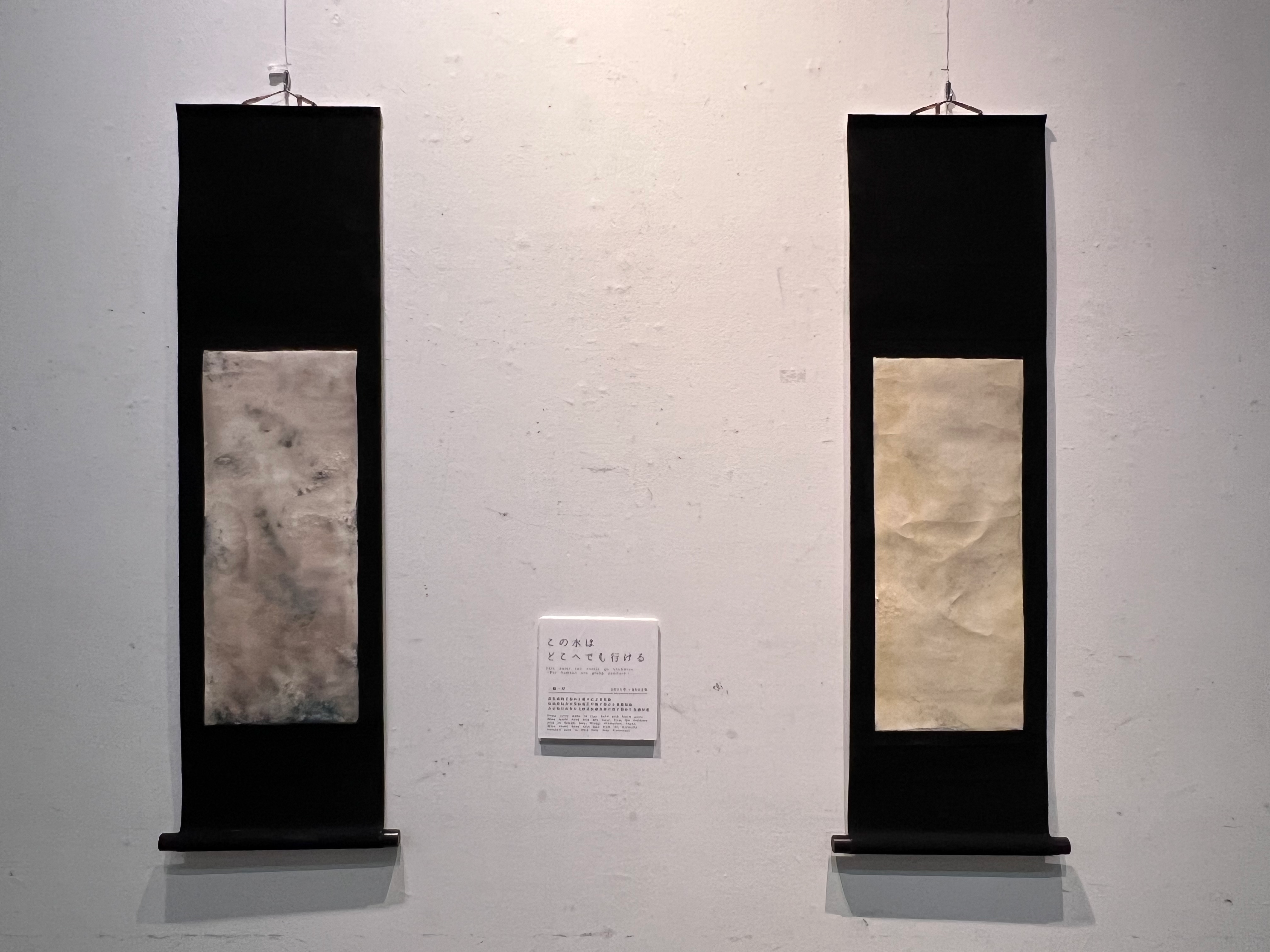
材料・技法:黒色塗料で染めた緞子による表装
被災地の水や泥で染色した和紙
(写真:宮城県仙台市荒浜地区の海で染めた美濃和紙、大分県日田市の土砂災害被災地の泥と現地で拾った画材で染めた美濃和紙)
サイズ:二幅一対
文化財レスキューの現場にて見た光景を紙に映す。
被害を受けた土地の記憶を写し取り、同時に、リサーチが時に搾取構造や非対称性を持つことに自覚的であること。

社会問題等を表現などで取り扱うとき、被災地とそれ以外、被災者と作者の間に非対称性が生じ、ともすれば搾取構造になる恐れがある。
2011年の東日本大震災発生当時、九州各地でも東北にエールをとの名目で多くの美術家やクリエイターがそれらを行っていたが、作品や表現が現地の当事者を傷つける現場にも立ち会うことがあった。
痛みにどう対峙するか、社会問題をどう扱うかはいまだに課題でありますが、当時出した自分なりの態度がアートの外でアートを見つめることであり、社会に対峙することそのものである。


ーーーーーーーーーーーーー

2011年3月に発生した東日本大震災を目の当たりにした時、たまたま「生き残ってしまった」自分の命をどうするかと考え、これまでアーティストとして行っていた表現ではなく文化財レスキューのボランティアを行うことを選びました。

当時、私は現地で写真の洗浄を主に行っており、作業を行う中で地域に住んでいた方々から震災発生当時のお話を伺う機会がありました。
被災地の状況は筆舌に尽くしがたく、多くの命や生活が一瞬にして奪われてしまったことをまざまざと見せつけられました。

海岸の慰霊碑に手を合わせていたとき、巡回に来ていらっしゃった警察官の方から震災時にご自身を庇った上司を目の前で亡くされたお話を聞き、何も言葉を発することができませんでした。

警察官の方は、自分は傷と共に生きることと地域の文化や芸術で人を鼓舞することを選んだ、と話して去っていかれました。

目の前に広がる灰色の海は静かに凪いでいました。

スケッチをしよう、という浅はかな思いで持ってきていた画材を広げることは出来ませんでした。
持っていきていた紙を波打ち際に沈め、せめてこの景色を忘れまいと思うことしか出来ませんでした。

その後、表現をすることとは別に、資料保存の実務に目を向けたことも、当時は「アーティストが表現を捨てた」と批判されることもありました。
当時、実際の痛みや被害に対峙せずに制作を行うことへの欺瞞を感じたことは事実であり、同時にアートから逃げた形と見られるということも否めません。
いまだに正しい答えは出せていません。
しかしながら、文化財保存修復や学芸員など、文化を支えて繋げることを明確に意識し始めたのはこの頃からであり、現在も文化財レスキューの募集がある際には可能な限り参加を続けています。


I capture on paper the scenes I witnessed at cultural property rescue sites.
I aim to record the memories of the affected areas while remaining conscious that research can sometimes involve exploitative structures and asymmetries.

When addressing social issues through artistic expression, an asymmetry can arise between disaster-stricken areas and other regions, as well as between victims and the artist, which can easily lead to exploitative structures.

At the time of the 2011 Great East Japan Earthquake, many artists and creators across Kyushu were engaging in such activities under the banner of “sending encouragement to Tohoku,” but I also witnessed instances where their works and expressions ended up hurting those directly affected in the affected areas.
How to confront pain and how to address social issues remain ongoing challenges, but the stance I adopted at that time was to view art from outside the realm of art itself—which is, in itself, a form of confronting society.


ーーーーーーーーーーーーー


In late 2010, while still a student, I suffered physical and mental health issues after being a victim of sexual violence during my job search. From then on, I barely managed to survive, repeatedly struggling with depression and suicidal thoughts.

At that time, there were few support measures for victims of sexual violence or those with mental health issues, and prejudice was rampant. Consequently, I received no understanding from my family and suffered under the prying eyes of those around me. I wanted to shut myself away and rest, but at the time, there was still a prevailing social climate that viewed such behavior as “self-indulgence” and therefore unacceptable.

When I witnessed the Great East Japan Earthquake that struck in March 2011, I pondered what to do with my life—a life I had “somehow managed to survive”—and chose to volunteer in cultural property rescue efforts rather than continue my artistic expression.

At the time, I was primarily cleaning photographs on-site, and while working, I had the opportunity to hear stories from local residents about what happened when the disaster struck.
The situation in the disaster-stricken area was beyond description; I was starkly confronted with the reality that so many lives and livelihoods had been taken away in an instant.

As I bowed my head in prayer at a memorial on the shore, a police officer who was on patrol told me how he had lost his superior—who had shielded him—right before his eyes during the disaster, and I was left speechless.

The officer told me that he had chosen to live with his wounds and to inspire people through the region’s culture and art, and then he walked away.

The gray sea stretching out before me lay calm and still.

I couldn’t bring myself to unpack the art supplies I’d brought along on the flippant whim of “I’ll just sketch something.”
All I could do was dip the paper I’d brought into the water at the water’s edge, hoping at least to never forget this scene.

Later, when I shifted my focus from artistic expression to the practical work of preserving historical records, I was criticized at the time for “an artist abandoning their art.”
It is true that at the time, I felt a sense of hypocrisy in creating art without confronting the actual pain and damage; at the same time, I cannot deny that it was seen as a form of running away from art.
I still haven’t found the right answer.
However, it was around this time that I began to clearly focus on supporting and preserving culture through work such as the conservation and restoration of cultural properties and serving as a curator, and to this day, I continue to participate as much as possible whenever there are calls for volunteers in cultural property rescue efforts.