久不相見長毋相忘(長いこと会えなくても、いつまでも忘れないで)(2021~2023)
Materials/Technique:
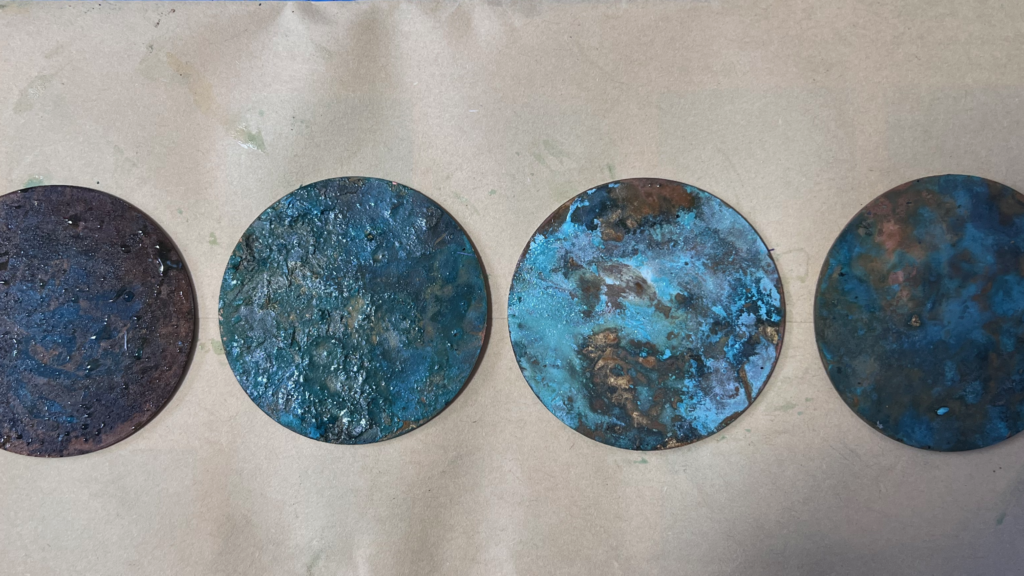
Bronze mirrors buried in various locations and dug up a year later.
Bronze mirrors corroded with tears, exhalations, and blood of the author
I bury copper plates in places with which I have had a connection, sites where disasters have occurred, the ruins of lost ways of life, and marginalized lands, then return to those locations one year later to dig them up.
The copper mirrors unearthed once more are corroded, and their rust reflects the memories and passage of time of that land.
Furthermore, to complete a work, I must always revisit the site and confront its historical context.
To capture and preserve a moment in time; to yearn for an eternity that can never exist.

ーーーーーー
“Though we have not seen each other for a long time, may we never forget one another”

The title is quoted from an inscription engraved on a bronze mirror excavated from the Yoshinogari Ruins (Saga Prefecture).
The bronze mirror bearing this inscription measures approximately 7.4 cm in diameter and is believed to have been crafted during the latter half of the Middle Yayoi period (approximately 2,050 years ago).
It is a mirror featuring a “linked-arc” pattern typical of the Western Han dynasty, and traces of vermilion remain on parts of its reverse side.
It was unearthed from the clay sealant between the rim of the jar coffin and the stone lid of a jar coffin tomb where the skeletal remains of a woman wearing 35 shell bracelets on both arms were discovered.

——————

For my “Burying Bronze Mirrors” series, I have primarily selected sites with which I have had a connection, locations where disasters have occurred, the ruins of lost ways of life, and marginalized lands.
My personal creed is to continue gathering memories and existences that have been marginalized. However, I constantly question myself and remind myself that this can also be a form of deception carried out from a position of safety.
The patterns of rust that appear on the bronze mirrors vary depending on the land where they were buried. In a sense, one could say they reflect the very nature of the land and the memory of time itself.
This beautiful rust reflects the memories of the lands inhabited by people who, despite living in the very heart of a cultural hub, are excluded from it.
The shape of the rust that appears on the bronze mirrors varies depending on the land where they were buried. In a sense, one could say that it captures the very nature of the land and the memory of time itself.
This beautiful rust reflects the memories of the lands inhabited by people who, despite living in the very heart of a cultural hub, are excluded from it.

Translated with DeepL.com (free version)